
Welcome back to another Two-Track Tuesday blog! Last week we talked about the software and equipment I use at DBS to mix and master a song. This week we’re going to hop into compression. What kinds of compressors there are and why it’s one of the most important effects in mixing. I hope you enjoy!
What is compression?
One of the most used effects besides eq (equalization), compression is commonly used to level out gain spikes and sometimes increase the volume of quieter parts of an instrument or vocal channel to maintain a stable level of a channel. Let’s go in to an example where we might use a compressor. When you record a vocal track, the person singing will naturally sing words louder or quieter than the last. We can also imagine the softer verse of a song where there’s not a lot of energy spent on belting the highest note. Then the chorus hits. It’s loud and energetic and the lyrics are sung higher and more euphoric. The vocal starts to pop out too much through the rest of the mix when these words are uneven in volume from the last. This is when we can choose to use compression to “massage'“ the track down to a cleaner, more level enhancement of the performance.
Types of compressors
There are 4 main types of compression. FET (Field Effect Transistor), Optical, Variable Mu (Tube), and VCA (Voltage Controlled Amplifier). Just to bring any kind of confusion off the table, all of these units do the exact same thing but in different ways. Knowing how they work will give you the reason why for example you would pick an optical over a FET style compressor.
FET Style Compressors
One of the most commonly used compressors is the FET style compressor. These units work using transistors to mimic the behavior of a vacuum tube, regulating signal amplitude through an electrical field to achieve lightning-fast, aggressive gain reduction. The most important thing to note about this type is how fast it can react. Also note that the time it takes to attack (react) and release can be changed for many applications. Fast attack is used for taming sharp, instantaneous transients. Commonly applied to snare drum, vocals, drum bus (see bus channels below) and something like stabby trumpets. These instruments produce most of their volume within the first millisecond of the note played. Setting the attack too slow would result in the compressor not reacting fast enough to catch that spike and reduce the gain.
A slower attack setting is used to allow those initial spikes to be a little more transparent to “cut” through the mix. While fast attack can be very useful, it can also suck the life out of an instrument if used too aggressively. When we slow down the attack, it allows more of the natural sound to poke through without choking it off while still controlling the overall level of the dynamics.
When adjusting the release, you are deciding when the compressor lets go of the gain reduction. This can happen from 50 milliseconds on a fast setting or all the way to 1 second on the slowest setting. A fast release allows for the trail of the note to be completely transparent when you only want to control the transient or first half of the note. A smoother and more contained sound comes from a slow release when you want a more consistent level throughout. Common on instruments like bass guitar and to prevent a “pumping” like sound.
Although I have covered attack/release parameters in the FET style section, this approach and outcome will be the same for every other style of compression

Pictured above: Universal Audio 1176 LN FET Style Compressor
Input: Controls input gain resulting in more or less gain reduction
Output: Used to make up the gain that is reduced from the effect
Optical (Opto) Compression
An optical compressor works by converting the audio signal into light via an LED or bulb, which shines on a light-dependent resistor (LDR) to dictate attenuation. In result you get a smooth compression with a warm and transparent sound. One of the most famous optical compressors is the Teletronix LA-2A. Like the LA-2A it is common to find these units filled with tubes. A vacuum tube is a sealed glass tube with all the air sucked out, containing small metal parts that control the flow of electricity. Think of it like a faucet for electrical current — you can turn it up, down, or shape it. Before transistors existed, tubes were how all electronics amplified signals. So in a unit like the LA-2A, after the signal is compressed, it needs to be boosted back up cleanly. Tubes do this in a way that's slightly imperfect compared to modern circuits, but that imperfection is the point. So not only are these smooth compressors, because of the tubes they add beautiful warmth via tubes that enhance the sound and bring more tonal character out of the signal!
To be clear not all opto compressors have tubes and others have attack/release knobs unlike the LA-2A which has a fixed setting which cant be changed which gives it such an iconic sound. This compressor is great on just about everything you run through it. Though, with its fixed attack and release parameters, it does have a slower attack than FET compressors making it less desirable for instantaneous spikes.
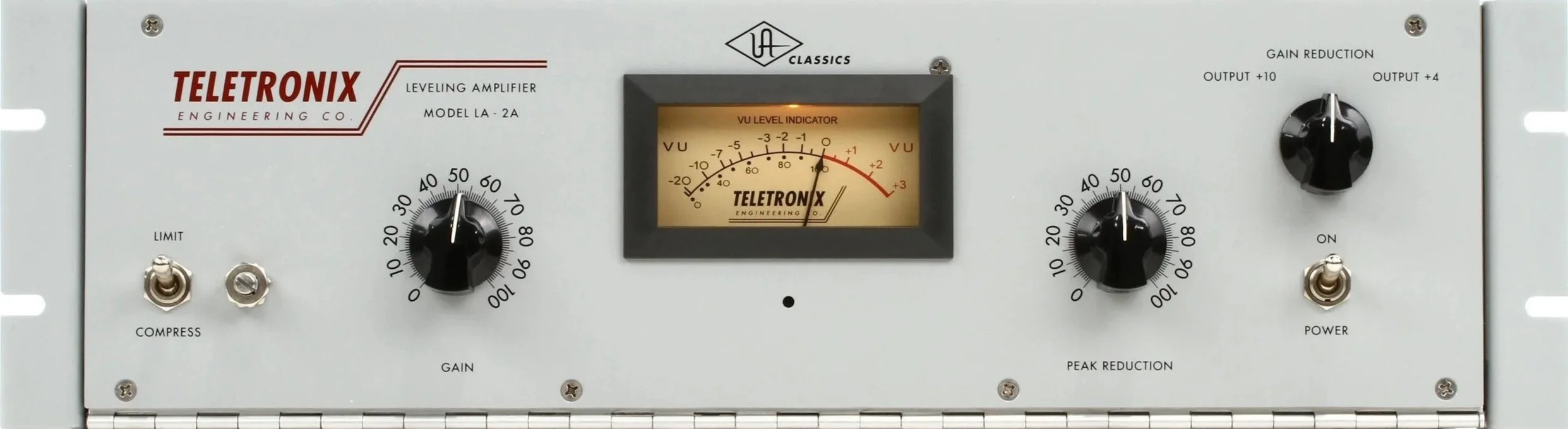
Pictured above: Teletronix LA-2A Optical Compressor
Variable Mu (bias) Tube compressor
A tube compressor works by feeding a signal to a vacuum tubes grid. As the signal increases the tubes bias voltage changes, reducing the gain and compressing the audio. As I mentioned above, tubes create warmth as well as harmonic saturation and distortion resulting in an enhancement to the signal. Vocals become warmer, bass becomes smoother, the signal in a way can be described as “creamy". This is a great way to thicken up a bass guitar or make vocals more present.
Up to this point, you can start to imagine why you might use one compressor over another. The goal of every compressor is to…compress. Though, you can see how they are also used to dress up signal to give more character on top of gain reduction.

Pictured above: Manley Variable Mu tube compressor
Note this is a stereo compressor. Most compressors can only compress one signal at a time. The Manley VariMu can compress two. Perfect for stereo signals like piano or overheads on drums.
VCA (Voltage Controlled Amplifier)
VCAs use a circuit to detect loudness of a signal that tells the amplifier to turn down the gain once it exceeds a set threshold. The amplifier in the name of this compressor is actually used to attenuate instead of amplifying like we know it. These compressors are known for being incredibly fast, transparent and accurate making them a great choice for bus compression. A bus is multiple signals routed into one channel. For example a drum bus would have the kick, snare, hihat, toms, overheads and room mics all in one channel. This for one makes it easier to control the overall volume of the drums with one fader instead of 10 faders, but another great reason for a bus is the ability to apply effects to the entire set of drums instead of having to put the same effect on every drum. Now we can compress the entire drum set on one channel instead of 10 compressors on each drum. Make sense?
VCAs are great for bus compression because they of their speed and transparency creating a “glue”-like effect. Glue is the sound of each instrument blending together. By reducing the peaks of every instrument, there is now a cohesion that sounds smooth and level. This is very important as a mix bus effect. The mix bus is just the entire mix, into a stereo channel. The same a a drum bus, the mix bus will be everything in the project routed to the output. We can put effects on that channel. Here we can put the VCA compressor to make the song sound smooth. No instruments poking out more than the other.
A thing about VCAs is that they don’t use tubes or transistors which “color” the sound with the warmth and pleasant distortion like the tube and opto compressors do. This is great because chances are, we have already used those compressors on channels like the bass, vocals, guitars etc…Having the ability to compress and leave the signal untouched in the end keeps the mix clean and doesn’t add more harmonics which may start to clog the warmth up making it sound muddy or unbalanced. This is another reason to use a VCA compressor. See it more like an automated volume knob that turns down when it senses the volume is too loud at the desired threshold.

Pictured above: API 2500 VCA Bus Compressor
I hope you liked this weeks Two-Track Tuesday about compression. Take a minute to let me know any questions you might have, I’d be happy to answer them. The blog will be back in two weeks!
Thank you for reading - Matt