Welcome back to Two-Track Tuesday! Today is going to be about what mixing and mastering is and why it’s important. So grab a coffee and a spot to enjoy this 3rd blog on my website.
What is mixing?
When you send your song to get mixed, it doesn’t just run through computer programs and magically turn into a releasable product. This is where mixing engineers come into play. Engineers are the key part in capturing what your vision is in your project, and translating it into a coherent feeling for the audience.
DAW (Digital Audio Workstation)
As there are engineers, there is also software. As an engineer, the first thing you need is software that can load in audio tracks from recording sessions. In this day and age, engineers are working in a digital world. Everything used to be analog. Picture in your mind that big mixing board with all the buttons and sliders that you see in a studio. What we are doing now is taking the whole studio and shoving it into a program that can handle all of that right on your computer screen. This type of software is called a DAW (Digital Audio Workstation). Engineers drag your audio files into DAWs like Pro Tools, Logic, Studio Pro, Ableton, Reaper and FL Studio. The amount of different DAWs can get pretty overwhelming, but all-in-all, they do the same thing in different ways. The industry standard for the last 30 years has been Pro Tools. Though there are reasons each DAW is preferred, we won’t cover that here.
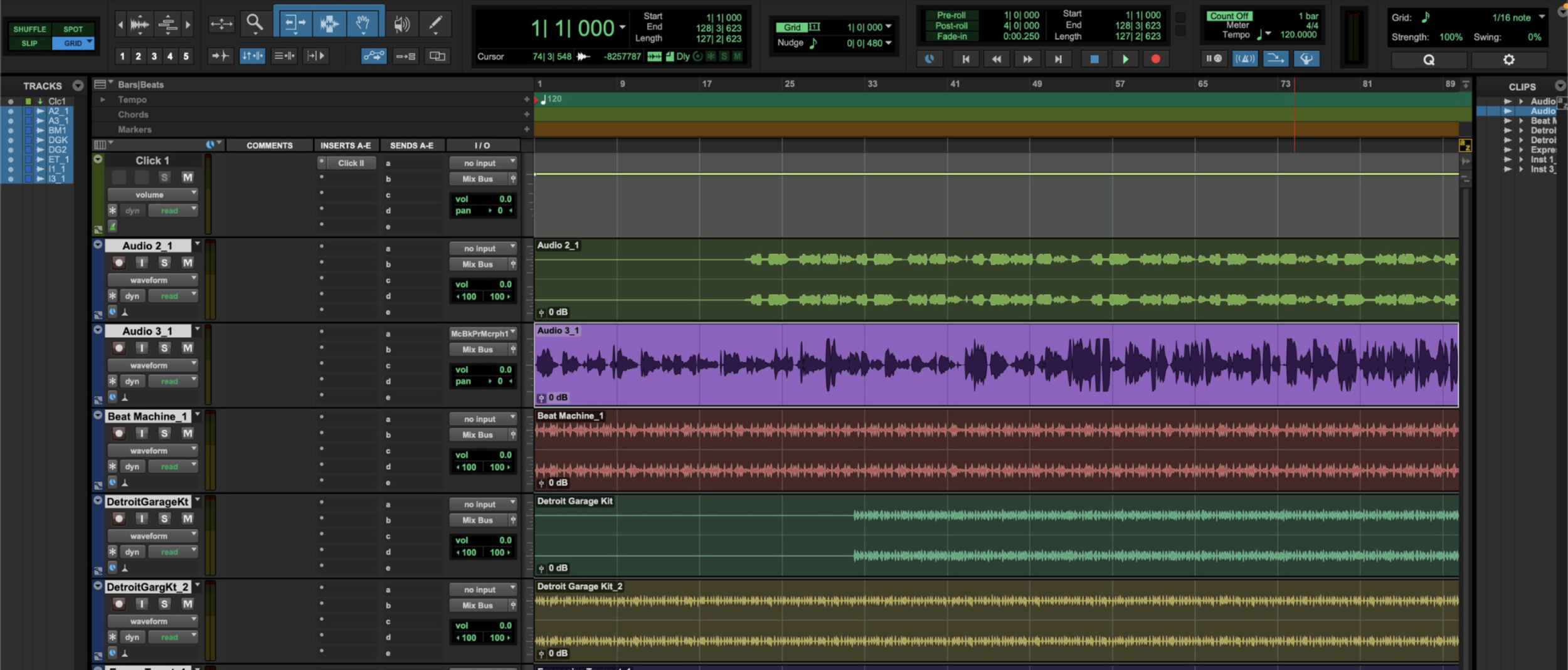
Pictured above: A view of the pro tools editing window showing waveforms of each channel.
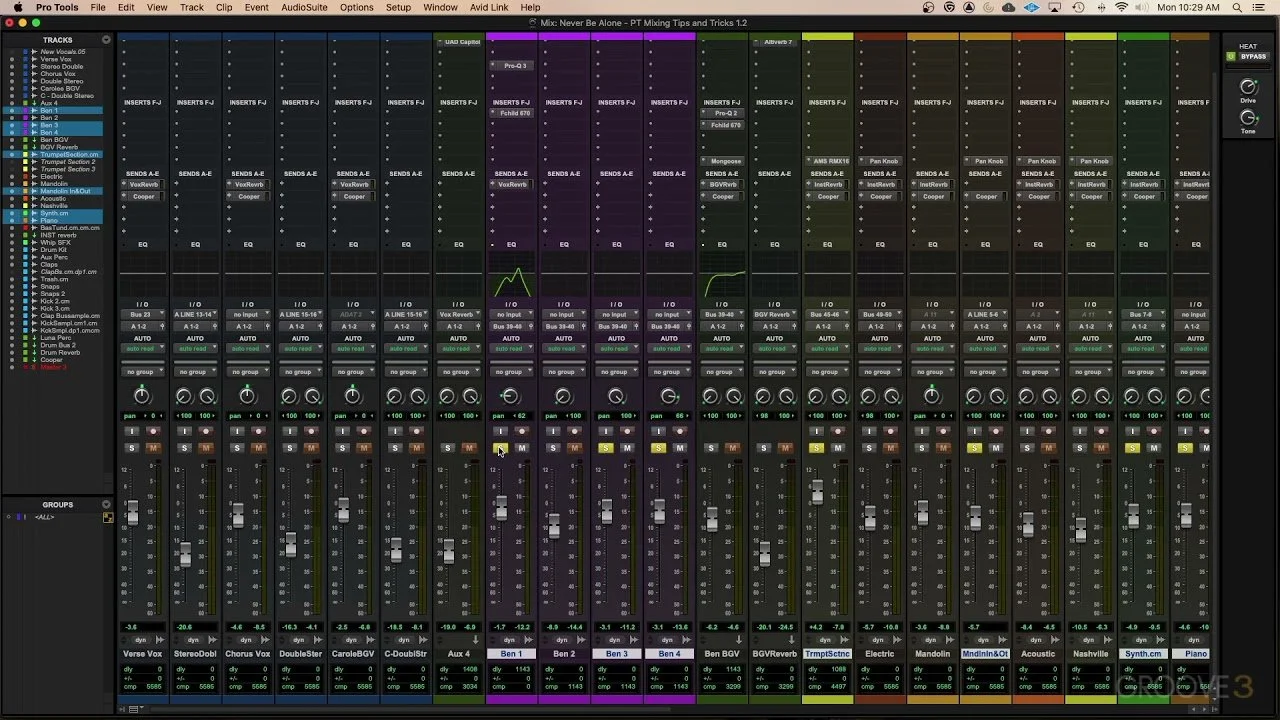
Picture above: A view of the mixing window of pro tools where the mixing magic happens.
Plugins, effects and hardware
After choosing a DAW, it now has to be considered which plugins will be used. Plugins consist of compressors, equalizers, effects like reverb and delay, limiters, saturators and really much more. I know what you’re thinking…HOW DO YOU PICK ONE?! As your audio engineer, this is where the expertise and experience come into play. This is all trial and error. No engineers use the same plugins across a project. We all pick our favorites based on how well they get to the sound we’re looking to achieve. Most plugins are based on physical equipment that used to stack tall in studios. Made to react and sound just like the hardware it’s cloned from, this is also a choice an engineer will make. Hardware? Or plugin? Stay tuned for a future blog post on plug-ins and what all these effects do and sound like.
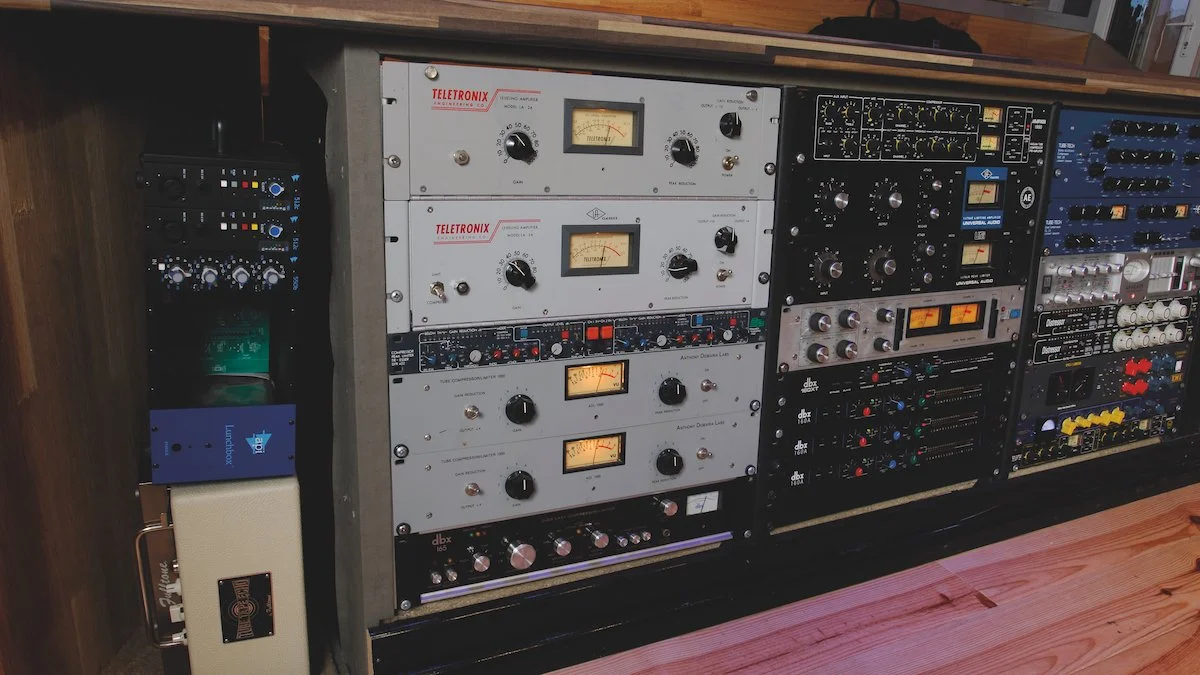
Above is a rack full of hardware. Physical effects run on tubes, capacitors, resistors, transistors and wires.
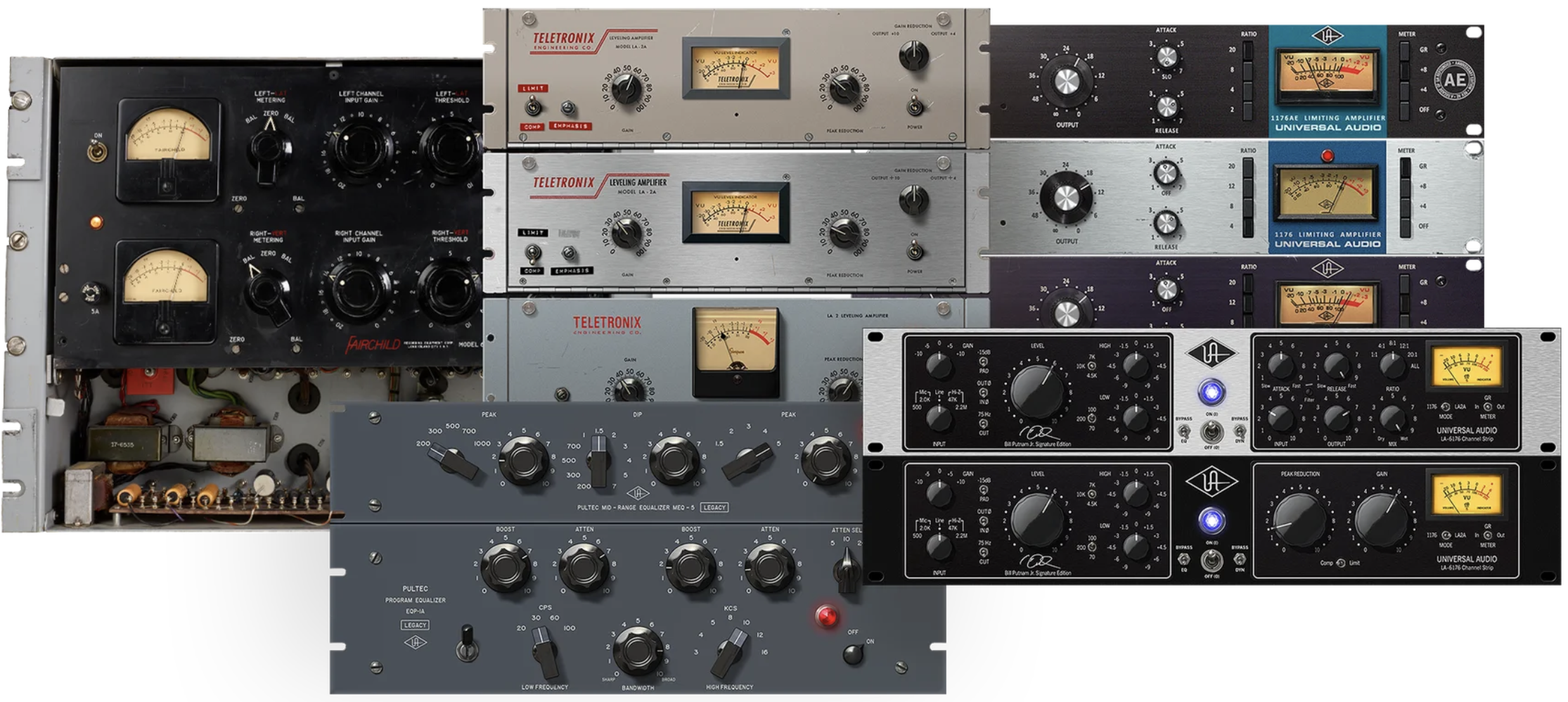
Pictured above: an image of plugins. Digital software recreations of hardware that has paved the sound of audio for decades. Much quicker to work with, cost effective, and very close to the original sound of their clones.
Finally, to mixing.
Now that we have covered the necessary tools to start mixing, we get to have FUN! After loading the audio files in to a DAW, what’s next is to get the mix sounding as good as possible without the use of plugins. This involves adjusting the volume of each channel as needed to ensure no instrument is overpowering another. The same goes for vocals. Background vocals must sound level and in some cases, even spread out in to the left or right ear which is called “panning” or “pan”. This is a knob that is by default, at 0 or center, in the middle. If you turn the knob to the right, that channel is only heard in the right ear. Vice versa when turning the knob to the left. Say you record two background vocal tracks, if you keep them both at center, they will sound like they are right in front of you. Now pan one vocal to the left and the other to the right. Now you have a stereo sound where you feel like you're standing in-between them. This is not only a cool effect, but also necessary to give space in the mix for every track to stand out without being too loud.
After I have a good sound after adjusting volume and pan, I start to focus on plugins. Starting with the things that pop out to me first. I like to start with compression and equalizing the drums. Next I work my way to bass, guitar, keys, synths, then horns to vocals. Basically what I’m doing is starting from the bass frequencies and working my way up. But there’s no exact way to do this. I find that dealing with the frequencies that carry the most energy (bass frequencies), need tweaking first to my ears. Next laying middle and treble frequencies (guitar, keys, vocals) above that is what makes a clean mix. Again there is no “right” way to do anything in mixing. This is just the process that works for me. I might not even do the same thing on a different mix. It all depends. The key to a good mix, is a good recording. Fixing is not the job. It’s about enhancing.
Issues I’d be looking for are tone, does the kick drum sound deep and punchy? Or is it flat? Is the bass supporting the band? Does it sound thin? Are the guitars filling out the space they need to? Are the words in the vocals inconsistent in volume from one another? You may want to fix something like this in the vocals. My process might be to go in and adjust the volume of every word so they have the same loudness for a very controlled consistency. I could also use compression. A compressor in this instance will use gain (input volume), to sense when a signal gets louder. It reduces dynamic range so you have a much more consistent sound all with the turn of a knob or two instead of editing every word. Mixing is never the same. I run into instances I’ve never had to approach with every project in one way or another. This is the reason you can’t just load a song into the same mix every time with the same settings and parameters expecting to get the same result even with the same instrumentation.
To sum everything up, mixing is all about enhancing the sound. If the recording is good, the best thing to do in some cases is to leave the track alone entirely! It’s easy to get excited about all the effects you can include especially if you pay for them! Though, how does it make the listener feel? This is what is most important.
What is mastering?
Mastering is the last step in post-production. You can look at this as polishing, balancing and optimizing a stereo track for release. We talked all about the process of having control of every channel, every instrument and vocal track during mixing while in mastering there is only one stereo track. The mixer, assembled the car. The master paints and polishes it so it looks great. The mastering engineer can’t take parts off and change them now. The car’s already done and assembled. Make sense??
Mastering studios have a lot of the same equipment and plugins that mixing engineers will use during their process. The use will be different though. The process of mastering is made up of small changes that don’t overpower the tone, and overall dynamic range of the mix. When I listen through the song, it might present something that I want to hear more, or less of. For example I hear that the low end bass frequencies are a little too powerful. To change that I can take an EQ (equalizer) to roll just those frequencies down without touching the mids and treble freq. Even though you can use a lot of the same equipment/plugins as mixing, there are a plethora of them for mastering. Mastering plugins will be much more transparent. Some will also have what is called mid/side processing or m/s which allows you to control what frequencies are heard in the sides or in the middle of the stereo image.
Once I have a tone I’m happy with, I add the “glue”. Glue is adding very subtle compression. Remember compression reduces the overall dynamic range of the signal you pipe through it so you need to be careful not to use too much of this glueing technique or you will start to choke the dynamics of the song. I only add a small amount to just contain the band a little bit. There are ways you can exploit this technique to get pretty cool sounds…that’s for another blog!
The last and final part of mastering is to increase the volume to a level that matches the competitive loudness of other commercially released songs. You don’t want your song to be quieter than the last song you heard while streaming a playlist! It must be loud! Believe it or not through the mid 90s to almost 2010, mastering was all about the “Loudness War”. This was when engineers were pushing vinyl to the limit on who could have the loudest albums! Having loud albums was cool and intense! Though increasing volume that high (0 decibels full scale or 0dBFS) will result in lower dynamic range. Anyway there’s a little history lesson!
Mixing and mastering are essential final steps in music production that turn raw recordings into polished, professional, and commercially competitive songs. Mixing balances individual instruments for clarity, coherency and depth, while mastering prepares the final stereo file for consistent, high quality playback across all devices, ensuring proper loudness and translation to the listener.
I hope you enjoyed this read! Hopefully this helps in understanding what you will get from me when working with DBS.
Comments and questions are welcome and encouraged!